Wire Gauge Chart: Complete AWG Size & Ampacity Guide
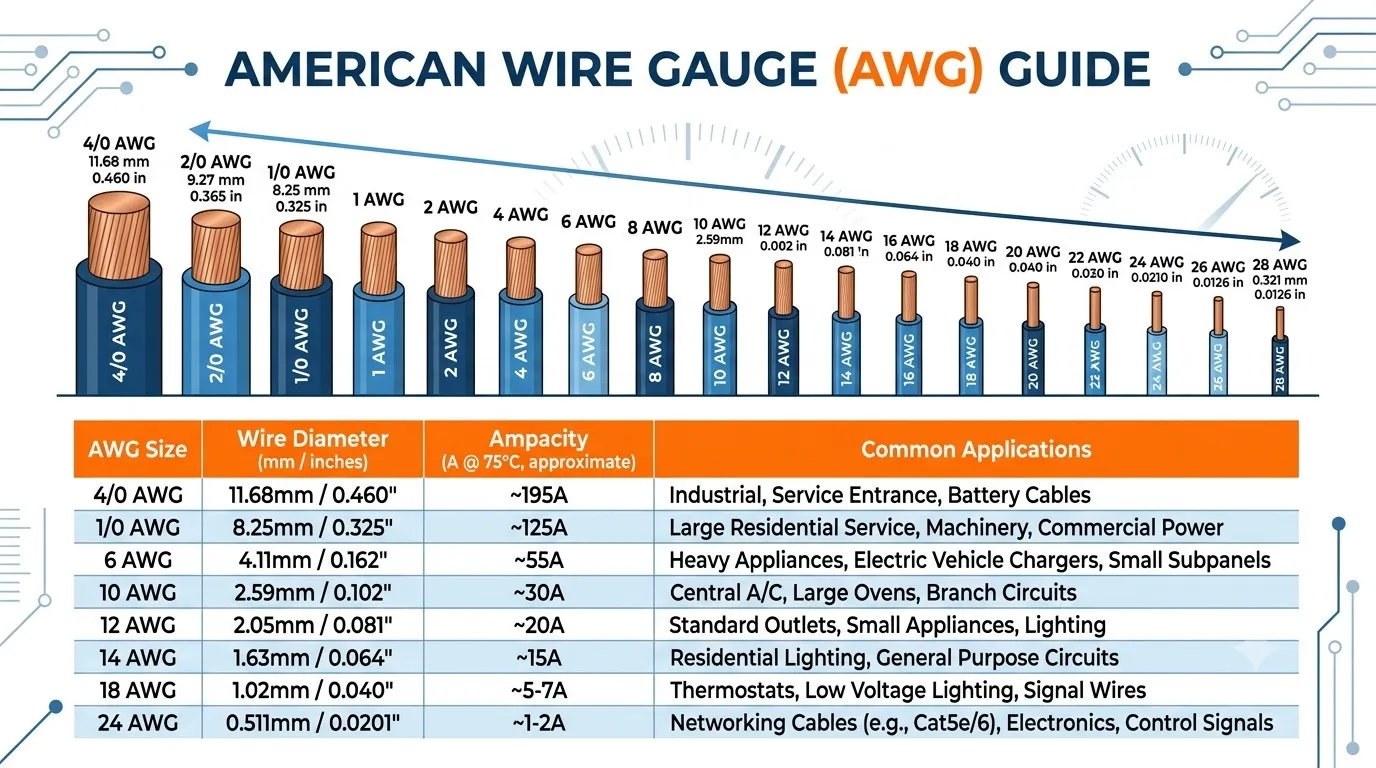
A wire gauge chart helps you choose the correct wire size for your electrical project. It shows the wire diameter, cross-sectional area, and the amount of current a wire can safely carry, so you don’t have to guess whether a conductor is up to the job. Whether you are wiring a home, installing a car audio system, connecting solar panels, or working on a DIY electronics build, using the right wire gauge directly improves both safety and performance.
The American Wire Gauge (AWG) system is the most common wire sizing standard in the United States, and it works on a simple but easy-to-misread scale: lower gauge numbers represent thicker wires, while higher gauge numbers represent thinner wires. For example, a 10 AWG wire is noticeably thicker than a 20 AWG wire and can safely carry far more current as a result.
Many people search for a wire gauge chart because they want a quick answer, but choosing the right wire actually involves more than reading a single number off a table. You also need to weigh the current load, the length of the run, the conductor material, the insulation type, and the environment the wire will live in once installed. This guide walks through all of that in plain language how the AWG system works, how to read a wire gauge chart correctly, and how to pick the right size for your specific application with easy-to-scan tables and real examples along the way for both beginners and working professionals.
Quick Wire Gauge Chart (At a Glance)
If you’re looking for a quick answer, the chart below offers a general guide to the wire sizes most commonly used in North America. These recommendations are based on typical copper conductors, so treat them as a starting point rather than a final answer always verify the exact wire size against your local electrical code, your installation conditions, and the equipment manufacturer’s specifications before you buy or install anything.
| Circuit or Application | Recommended Wire Gauge |
| 15-amp lighting circuit | 14 AWG |
| 20-amp outlet circuit | 12 AWG |
| 30-amp water heater or dryer | 10 AWG |
| 40-amp circuit | 8 AWG |
| 50-amp circuit | 6 AWG |
| 100-amp service | 2 AWG |
This quick reference works well for common household applications, but the correct wire size also depends on cable length, conductor material, insulation rating, ambient temperature, and how much voltage drop you’re willing to tolerate over the run.
What Is a Wire Gauge Chart?
A wire gauge chart is a reference table that helps you choose the correct wire size for a specific electrical application.
A typical wire gauge chart includes:
- AWG size
- Wire diameter (inches and millimeters)
- Cross-sectional area
- Resistance
- Current carrying capacity (ampacity)
- Common applications
Instead of guessing which wire to use, you can line up several sizes in the chart and pick the one that actually matches your project’s electrical requirements. For example, if you’re installing a 20-amp household circuit, the chart shows that 12 AWG copper wire is the standard choice. Likewise, if you’re wiring a powerful car amplifier, the same chart helps you decide between something like 4 AWG or 1/0 AWG based on the amplifier’s current draw and how far the cable has to run.
Did you know? Every three-step decrease in AWG size roughly doubles the wire’s cross-sectional area, allowing it to carry significantly more current.
Using a wire that’s too small can cause excessive heat, unacceptable voltage drop, and even equipment damage, so it’s not a corner worth cutting. Going larger than strictly required is generally safe and often improves efficiency, though it can add to installation cost and make the cable harder to route.
What Does AWG Mean?
AWG stands for American Wire Gauge. It’s the standard system used across North America to measure the diameter of solid, round, non-ferrous electrical conductors — most commonly copper and aluminum wires.
One of the more counterintuitive features of the AWG system is that the numbering runs in reverse: a lower AWG number means a thicker wire, while a higher AWG number means a thinner one.
| AWG Size | Relative Thickness |
| 4 AWG | Very Thick |
| 8 AWG | Thick |
| 12 AWG | Medium |
| 18 AWG | Thin |
| 24 AWG | Very Thin |
This reverse numbering trips up a lot of beginners at first, but once the pattern clicks, reading any wire gauge chart becomes much easier.
The AWG system shows up across a wide range of industries, including:
- Residential electrical wiring
- Commercial buildings
- Automotive wiring
- Marine electrical systems
- Solar installations
- Industrial equipment
- Audio systems
- Electronic devices
Because AWG is standardized, manufacturers can produce wire with consistent dimensions from batch to batch, which in turn makes it much easier to calculate electrical resistance, current capacity, and voltage drop with confidence. Did you know? A lower AWG number always indicates a thicker conductor—even though the numbering may seem backward to beginners.
History of the American Wire Gauge (AWG)
The American Wire Gauge system has been in continuous use for more than a century and a half — it was introduced back in 1857 as a standardized method for measuring wire sizes across the United States.
Before AWG became the norm, different manufacturers used their own proprietary sizing methods, which meant the “same” wire size could have a different actual diameter depending on who made it. That inconsistency created real confusion on job sites and raised the risk of installation errors.
The AWG standard fixed this by assigning one fixed diameter to every gauge number, and ever since, engineers, electricians, and manufacturers have relied on it to keep electrical installations consistent and predictable. You’ll sometimes see the system referred to as the Brown & Sharpe Wire Gauge, a nod to the Brown & Sharpe Manufacturing Company that originally developed it.
Today, wire dimensions under the AWG system are standardized under ASTM B258 — the Standard Specification for Standard Nominal Diameters and Cross-Sectional Areas of AWG Sizes of Solid Round Wires. This standard is what keeps manufacturers producing wire with consistent diameters and cross-sectional areas, ensuring compatibility and accuracy across different electrical applications. Although many countries have since moved to metric wire sizing, AWG remains the preferred standard throughout the United States and Canada.
| Standard | Region | Used For |
| AWG | USA & Canada | Electrical wiring |
| SWG | UK | Craft and some legacy applications |
| IEC Metric (mm²) | Europe & many other countries | Electrical installations |
This helps users who encounter different sizing systems.
How Does the AWG System Work?
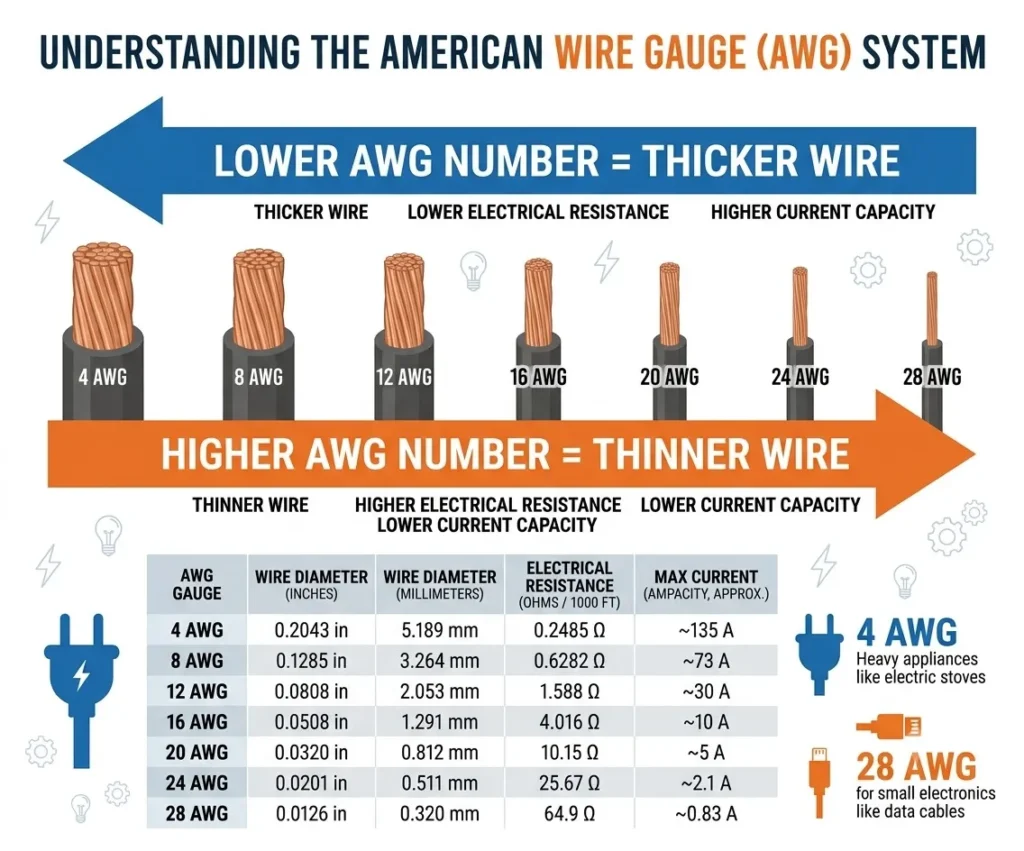
Step 1 – Identify the electrical load (amps).
↓
Step 2 – Measure the cable length.
↓
Step 3 – Choose the conductor material (copper or aluminum).
↓
Step 4 – Check the ampacity chart.
↓
Step 5 – Verify NEC or local code requirements.
Why Engineers Use Wire Gauge Standards
Engineers rely on standardized wire sizes to design electrical systems that are safe, reliable, and efficient. The AWG system provides consistent measurements for wire diameter, cross-sectional area, and electrical resistance, which makes it far easier to calculate current capacity and voltage drop with accuracy. Because the sizing is standardized, engineers can compare conductors side by side, run accurate electrical calculations, and confirm compliance with industry standards and electrical codes without reinventing the wheel on every project.
The AWG system follows one simple principle. In practical terms, a thicker wire gives you:
- Lower electrical resistance
- Higher current carrying capacity
- Less voltage drop
- Better performance over long distances
| Wire Size | Thickness | Typical Use |
| 24 AWG | Very Thin | Electronics and sensors |
| 18 AWG | Thin | Low-voltage wiring and speakers |
| 14 AWG | Medium | Household lighting circuits |
| 12 AWG | Thick | 20-amp branch circuits |
| 10 AWG | Thicker | Water heaters and air conditioners |
| 4 AWG | Heavy Duty | Batteries, inverters, and amplifiers |
| 1/0 AWG | Extra Heavy | High-current power systems |
That said, the correct wire size depends on more than current alone wire length, installation method, ambient temperature, and conductor material all factor in too. It’s worth considering the complete installation rather than leaning on the gauge number by itself.
Complete Wire Gauge Chart (AWG)
How to Read a Wire Gauge Chart
A wire gauge chart packs in several measurements that, together, help you choose the right conductor for your electrical project. Understanding what each column actually represents makes the whole selection process much less intimidating.
| Column | Description |
| AWG | Standard wire size number used in North America |
| Diameter | Physical thickness of the conductor |
| Cross-Sectional Area (mm²) | Amount of conductive material inside the wire |
| Ampacity | Maximum current the wire can safely carry under typical conditions |
| Common Applications | Typical uses for that wire size |
For example, if you need to install a 20-amp household circuit, you’d look up 12 AWG in the chart to check the wire diameter, cross-sectional area, and typical application, confirming it’s suitable before you buy the cable. Just keep in mind that a wire gauge chart should always be used alongside your local electrical code, since ampacity can shift depending on insulation type, installation method, and ambient temperature.
The chart below gives a quick comparison of common American Wire Gauge sizes, including diameter in both inches and millimeters, cross-sectional area, and typical applications.
| AWG | Diameter (mm) | Diameter (in) | Area (mm²) | Common Applications |
| 4/0 | 11.684 | 0.4600 | 107.2 | Industrial power distribution |
| 3/0 | 10.405 | 0.4096 | 85.0 | Service entrance cables |
| 2/0 | 9.266 | 0.3648 | 67.4 | Battery banks |
| 1/0 | 8.252 | 0.3249 | 53.5 | High-power amplifiers |
| 2 | 6.544 | 0.2576 | 33.6 | Solar systems |
| 4 | 5.189 | 0.2043 | 21.2 | Winches and inverters |
| 6 | 4.115 | 0.1620 | 13.3 | EV charging equipment |
| 8 | 3.264 | 0.1285 | 8.37 | Subpanels and amplifiers |
| 10 | 2.588 | 0.1019 | 5.26 | 30-amp circuits |
| 12 | 2.053 | 0.0808 | 3.31 | 20-amp household circuits |
| 14 | 1.628 | 0.0641 | 2.08 | 15-amp lighting circuits |
| 16 | 1.291 | 0.0508 | 1.31 | Extension cords |
| 18 | 1.024 | 0.0403 | 0.823 | Speaker wire |
| 20 | 0.812 | 0.0320 | 0.518 | Automotive accessories |
| 22 | 0.644 | 0.0253 | 0.326 | Sensors and signal wiring |
| 24 | 0.511 | 0.0201 | 0.205 | Electronics and communication cables |
| 26 | 0.405 | 0.0159 | 0.129 | PCB connections |
| 28 | 0.321 | 0.0126 | 0.081 | Data cables and small electronics |
AWG to Millimeters (mm) Conversion
Many countries measure wire sizes in millimeters rather than AWG, which means people often need to convert between the two systems. Getting comfortable with this conversion makes it easier to compare wire from different manufacturers and choose the right conductor no matter where it was made.
One thing worth knowing up front: the AWG system doesn’t step up or down in equal increments. Each gauge is derived from a mathematical formula, so the size difference between two consecutive gauges isn’t constant. The table below shows some of the most common AWG-to-millimeter conversions.Although AWG dominates in the United States and Canada, many countries specify wire sizes in square millimeters (mm²) under International Electrotechnical Commission (IEC) standards instead. Converting between AWG and metric sizing becomes especially useful when you’re working with imported equipment or international electrical components — if you buy gear from Europe or Asia, for instance, you may find the wire size listed only in millimeters, and a conversion chart like this one lets you translate that back into familiar AWG terms.
AWG vs. SWG vs. Metric Wire Sizes
Different regions of the world rely on different wire sizing standards, and although some of the names sound similar, the systems themselves are not interchangeable.
| Standard | Common Region | Measurement Method |
| AWG (American Wire Gauge) | United States & Canada | Wire diameter |
| SWG (Standard Wire Gauge) | United Kingdom | Wire diameter (different scale from AWG) |
| Metric (mm²) | Europe, Asia & Australia | Cross-sectional area |
A common mistake is assuming that the same gauge number means the same diameter in both AWG and SWG — it doesn’t. A 20 AWG wire, for example, is not the same size as a 20 SWG wire, so if you’re sourcing electrical components or jewelry wire internationally, always confirm which sizing system the supplier is actually using before picking a replacement.
Beyond diameter, many electrical standards also describe conductors by their cross-sectional area in square millimeters (mm²), which gives a more direct read on how much metal is actually inside the wire — and a larger cross-sectional area means the conductor can carry more current at lower resistance. Here are some common AWG-to-mm² conversions:
| AWG | Area (mm²) |
| 4/0 | 107.2 |
| 3/0 | 85.0 |
| 2/0 | 67.4 |
| 1/0 | 53.5 |
| 2 | 33.6 |
| 4 | 21.2 |
| 6 | 13.3 |
| 8 | 8.37 |
| 10 | 5.26 |
| 12 | 3.31 |
| 14 | 2.08 |
| 16 | 1.31 |
| 18 | 0.823 |
| 20 | 0.518 |
| 22 | 0.326 |
| 24 | 0.205 |
Since many international electrical products list only mm² rather than AWG, having both measurements on hand makes cross-referencing and selecting the correct wire far simpler.
Wire Diameter and Cross-Sectional Area
Wire diameter measures the thickness of the conductor, while cross-sectional area measures the amount of conductive material inside the wire.
| Wire Size | Diameter | Area |
| 18 AWG | 1.024 mm | 0.823 mm² |
| 14 AWG | 1.628 mm | 2.08 mm² |
| 10 AWG | 2.588 mm | 5.26 mm² |
| 4 AWG | 5.189 mm | 21.2 mm² |
Notice that while the diameter only roughly doubles across these sizes, the cross-sectional area increases much faster — which is exactly why thicker wires are able to safely carry so much more electrical load.
Wire Ampacity Chart
Wire ampacity isn’t determined by wire size alone. According to the National Electrical Code (NEC), the maximum current a conductor can safely carry also depends on factors like the insulation’s temperature rating, the installation method, ambient temperature, and how many conductors are bundled together. Because of that, the values in this guide should be treated as general reference points rather than universal limits that apply in every situation.
How to Calculate the Correct Wire Gauge
A wire gauge chart helps you select the right conductor, but before you can use one effectively, you need a reasonable estimate of how much current your electrical system will actually draw. The basic formula is:
Current (Amps) = Power (Watts) ÷ Voltage (Volts)
Example: Suppose you have a 1200-watt inverter running on a 12-volt battery. Dividing 1200 by 12 gives you 100 amps of current draw. Once you know that figure, you can turn to the wire gauge chart and pick a conductor capable of safely carrying 100 amps while keeping voltage drop within an acceptable range.
Keep in mind that this formula is only a starting point cable length, conductor material, ambient temperature, and installation method should all factor into your final wire size decision. In simple terms, ampacity is the maximum amount of electrical current a wire can safely carry without overheating, and getting it right helps prevent excessive heat, voltage drop, and outright electrical failures.
The NEC is clear that wire ampacity depends not just on conductor size but also on insulation temperature rating, installation method, ambient temperature, and other real-world conditions, so it’s worth always checking the latest applicable code before finalizing a wire size. Actual ampacity can shift based on:
- Wire material
- Insulation type
- Ambient temperature
- Installation method
- Cable bundling
- Local electrical codes
Professional electricians weigh all of these factors not just the raw gauge number when selecting conductors, and following the latest NEC requirements is what ultimately keeps an installation both safe and compliant. The table below shows typical ampacity values for common copper conductors used in general applications.
| AWG | Typical Ampacity |
| 4 | 70 A |
| 6 | 55 A |
| 8 | 40 A |
| 10 | 30 A |
| 12 | 20 A |
| 14 | 15 A |
| 16 | 10 A |
| 18 | 7 A |
| 20 | 5 A |
| 22 | 3 A |
| 24 | 2 A |
Always double-check the required ampacity against your local electrical code before starting any installation.
Wire Resistance Chart
Every electrical wire carries some amount of resistance, which limits current flow and causes voltage to drop over long distances. Thicker wires have lower resistance than thinner ones, meaning they waste less energy and deliver noticeably better electrical performance overall. The table below shows approximate resistance values for copper conductors.
| AWG | Resistance (Ω / 1000 ft) |
| 4 | 0.2485 |
| 6 | 0.3951 |
| 8 | 0.6282 |
| 10 | 0.9989 |
| 12 | 1.588 |
| 14 | 2.525 |
| 16 | 4.016 |
| 18 | 6.385 |
| 20 | 10.15 |
| 22 | 16.14 |
| 24 | 25.67 |
As wire length increases, total resistance climbs right along with it, which is why longer cable runs often call for a larger wire size to keep voltage loss under control.
Copper vs. Aluminum Wire
Copper and aluminum are the two most widely used conductor materials in electrical wiring, and while both carry electricity effectively, they behave quite differently in practice.
| Feature | Copper Wire | Aluminum Wire |
| Electrical Conductivity | Excellent | Good |
| Resistance | Lower | Higher |
| Weight | Heavier | Lighter |
| Flexibility | Better | Lower |
| Corrosion Resistance | Excellent | Good |
| Cost | Higher | Lower |
| Current Capacity | Higher | Lower |
| Common Uses | Homes, vehicles, electronics | Utility power lines, service entrances |
Copper remains the preferred choice for most residential, commercial, and automotive applications simply because it carries more current with less resistance. Aluminum, on the other hand, is lighter and less expensive, which is why it’s commonly used in large power distribution systems where weight and material cost matter more than raw performance.
Because aluminum has lower conductivity than copper, it generally requires a larger conductor to carry the same current safely so if you’re replacing copper wire with aluminum, expect to size up. Electrical codes also require connectors and terminals that are specifically approved for aluminum wiring, since mixing materials without the right hardware can create real safety issues.
Solid Wire vs. Stranded Wire
Another important decision is choosing between solid and stranded wire. Both can share the same AWG size, but they’re built for very different jobs.
| Feature | Solid Wire | Stranded Wire |
| Flexibility | Low | High |
| Strength | Higher | Moderate |
| Installation | Fixed wiring | Moving equipment |
| Cost | Lower | Slightly Higher |
| Common Uses | Household wiring | Automotive, marine, robotics, speaker cables |
Solid wire is made from one continuous conductor, which makes it well-suited for inside walls and electrical panels since it holds its shape reliably. Stranded wire, by contrast, is made up of many small conductors twisted together, so it bends easily without breaking that flexibility is exactly why it’s the go-to choice for vehicles, portable equipment, marine systems, and audio installations. As a rule of thumb, if the cable is going to move or vibrate regularly, stranded wire is almost always the better option.
Wire Gauge for Household Wiring
Residential electrical systems call for different wire sizes depending on the circuit and the load it needs to carry. The table below covers the most common household wire sizes.
| Circuit | Recommended Copper Wire |
| Lighting Circuits (15A) | 14 AWG |
| Kitchen & Bathroom Outlets (20A) | 12 AWG |
| Water Heater (30A) | 10 AWG |
| Electric Dryer | 10 AWG |
| Electric Range | 6–8 AWG |
| Main Service Entrance | 2 AWG to 4/0 AWG |
These sizes reflect common North American practice, but you should still confirm them against your local electrical code and the equipment manufacturer’s instructions before installing anything.
Wire Gauge for Automotive Wiring
Automotive wiring faces a different set of demands than household wiring vehicles deal with constant vibration, wide temperature swings, and often higher current loads, so most automotive installations rely on stranded copper wire for its flexibility and durability.
When installing a car amplifier, choosing the correct power and ground wire matters just as much as choosing the amplifier itself. A wire that’s too small can lead to excessive voltage drop, overheating, reduced amplifier performance, and blown fuses, so larger systems often call for 4 AWG, 1/0 AWG, or even heavier cable depending on the amplifier’s RMS power, current draw, and cable length.
| Application | Typical Wire Gauge |
| LED Lights | 18–20 AWG |
| Car Stereo | 16–18 AWG |
| Door Speakers | 16 AWG |
| Subwoofers | 12–14 AWG |
| Amplifier Power Wire | 4 AWG to 1/0 AWG |
| Battery Cable | 2 AWG to 4/0 AWG |
High-power amplifiers generally need thicker power cables to keep voltage drop and overheating in check.
Wire Gauge for Solar Systems
Solar power systems depend on efficient wiring to keep energy loss to a minimum, and because cable runs between panels, charge controllers, batteries, and inverters can be quite long, an undersized wire can cause noticeable voltage drop over that distance. The wire gauge you actually need depends on the solar panel’s output, the system voltage, the cable length, and the current flowing through it. Getting the wire size right — accounting for both conductor size and cable length — directly improves the overall efficiency of the system.
| Solar Component | Common Wire Size |
| Small Solar Panels | 12–14 AWG |
| Medium Systems | 10–8 AWG |
| Battery Connections | 4–2 AWG |
| Large Inverters | 2 AWG to 4/0 AWG |
When designing a solar system, it’s worth calculating the expected current and voltage drop up front, before you commit to a wire size.
Wire Gauge for Marine Wiring
Marine electrical systems operate in tough conditions moisture, vibration, and saltwater exposure are all part of the territory so marine-grade stranded copper wire with corrosion-resistant insulation is typically the recommended choice. Picking the right wire gauge for these systems helps ensure reliable performance while cutting down the risk of overheating and corrosion over time.
| Marine Equipment | Typical Wire Size |
| Navigation Lights | 16–18 AWG |
| Fish Finders | 16 AWG |
| Bilge Pumps | 12–14 AWG |
| Marine Batteries | 2 AWG to 4/0 AWG |
| Inverters | 4 AWG to 2/0 AWG |
Marine wire usually comes with corrosion-resistant insulation specifically designed to hold up in saltwater environments.
Wire Gauge for Industrial Equipment
Industrial machines, motors, pumps, and control panels often run under continuous electrical loads, so choosing the proper wire gauge helps minimize voltage drop, improve equipment reliability, and prevent overheating during long operating hours. Industrial wiring should always be sized according to the equipment’s specifications, the conductor’s insulation ratings, and the applicable electrical code and for high-current industrial equipment, larger conductors are typically used to keep power delivery efficient.
Wire Gauge for Speaker Wire
Speaker wire carries audio signals from the amplifier to the speakers, and choosing the correct size helps reduce signal loss, particularly over longer distances. The recommended gauge depends on both the speaker’s power and how far the cable needs to run.
| Speaker Distance | Recommended Wire Gauge |
| Up to 25 ft | 16 AWG |
| 25–50 ft | 14 AWG |
| 50–100 ft | 12 AWG |
| Over 100 ft | 10 AWG |
If your audio system uses high-powered subwoofers, stepping up to a thicker speaker wire can improve performance by reducing resistance along the run.
Wire Gauge for LED Lighting
LED lighting systems generally draw less current than traditional lighting, but selecting the proper wire size still matters for maintaining consistent brightness and minimizing voltage drop.
| LED Application | Typical Wire Size |
| Decorative LED Strips | 20–22 AWG |
| Cabinet Lighting | 18–20 AWG |
| Outdoor LED Lighting | 16–18 AWG |
| High-Power LED Systems | 14–16 AWG |
Longer LED installations often benefit from a larger wire size, since voltage naturally decreases over distance.
Wire Gauge for Electronics Projects
Many electronics projects rely on smaller wire sizes because they carry low current and need flexible conductors — think Arduino boards, Raspberry Pi projects, sensors, breadboards, robotics, communication devices, and PCB connections. Most hobby electronics use 22 AWG to 28 AWG wire, which keeps resistance low while keeping circuits compact and manageable. If a project carries higher current than typical, it’s worth double-checking the wire’s ampacity before installing it.
Wire Gauge for Jewelry Making
Wire gauge matters in jewelry making too, since different projects call for different thicknesses — thicker wire adds strength, while thinner wire is easier to bend, weave, and wrap by hand.
| Wire Gauge | Common Jewelry Uses |
| 18 AWG | Bracelets, heavy clasps, rings |
| 20 AWG | Ear wires, jump rings, general jewelry making |
| 22 AWG | Wire wrapping, head pins, wrapped links |
| 24 AWG | Delicate wrapping, pearls, small beads |
| 26 AWG | Fine wire wrapping and detailed work |
| 28 AWG | Wire weaving, wire knitting, intricate designs |
Many jewelry suppliers use either the American Wire Gauge (AWG) or Standard Wire Gauge (SWG) system, and since the two measure differently, it’s always worth confirming which standard a supplier is using before buying jewelry wire.
Wire Length and Wire Size
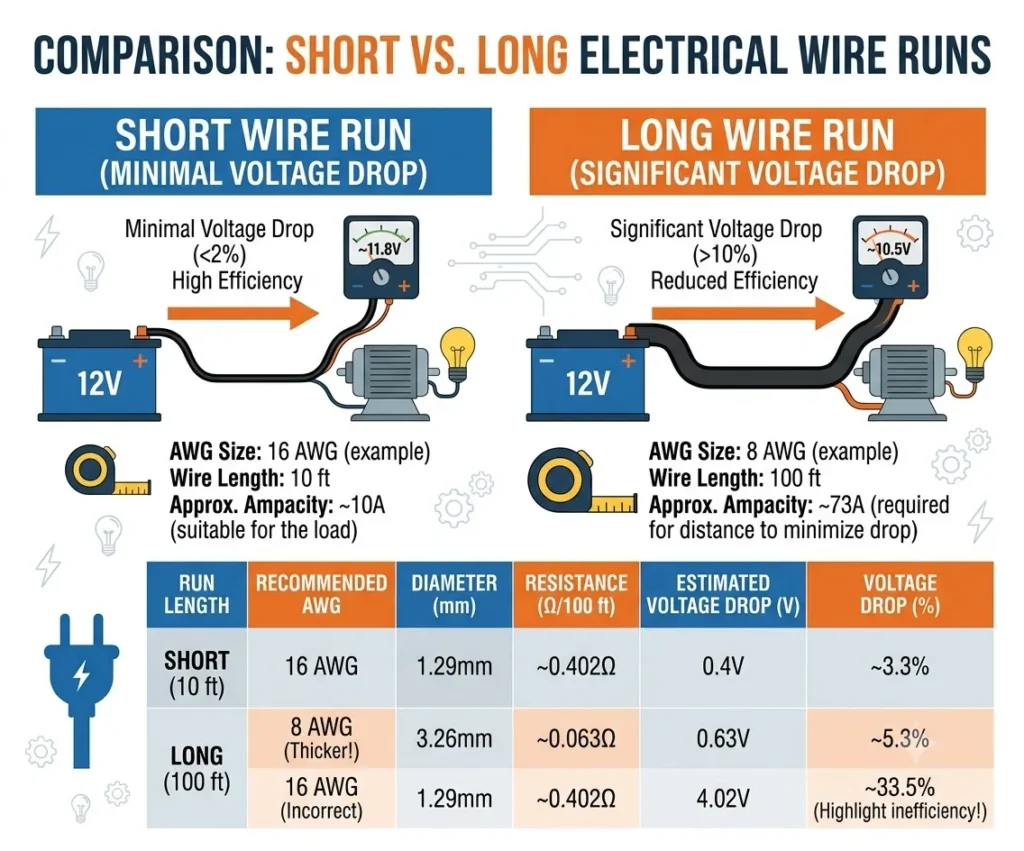
Wire length plays a bigger role in gauge selection than many people expect. As the distance a wire has to travel increases, so does its electrical resistance, which is why longer wire runs typically call for thicker conductors. Consider the following example:
| Wire Run | Better Choice |
| 15 feet | 14 AWG |
| 50 feet | 12 AWG |
| 100 feet | 10 AWG |
Voltage Drop Example
Voltage drop happens naturally as electricity travels through any conductor, and the longer the cable, the greater the resistance and the larger the resulting voltage loss. For example, if a 12-volt battery only delivers 11.4 volts at the load, the math works out like this:
Voltage Drop = 12V − 11.4V = 0.6V Voltage Drop Percentage = (0.6 ÷ 12) × 100 = 5%
Most electrical systems are designed to keep voltage drop as low as possible, and selecting a larger wire gauge is often the simplest way to reduce resistance and improve overall system efficiency, especially on longer cable runs.
Wire Temperature Ratings
Electrical wires are made with different insulation materials, and each type has its own maximum safe operating temperature. The three most common ratings are:
| Temperature Rating | Common Use |
| 60°C | Older residential wiring |
| 75°C | Commercial installations |
| 90°C | Modern electrical systems and industrial equipment |
Higher temperature ratings let wires operate safely under warmer conditions, but the final ampacity of a system is always limited by the lowest temperature rating of any single component involved — including terminals, breakers, and connectors. In other words, even if the wire insulation itself is rated for 90°C, the allowable ampacity may still be capped lower if the connected equipment is only rated for 75°C or 60°C.
Common Wire Gauge Mistakes to Avoid
Selecting the wrong wire size can hurt performance and create genuine safety risks, so it’s worth watching out for these common mistakes when working from a wire gauge chart:
- Choosing wire based only on its diameter instead of its ampacity
- Ignoring voltage drop on long cable runs
- Using aluminum wire without increasing the conductor size
- Mixing copper and aluminum conductors without approved connectors
- Ignoring insulation temperature ratings
- Using indoor-rated wire for outdoor installations
- Selecting wire based on peak power instead of continuous current
- Overlooking cable bundling and high ambient temperatures
- Using undersized extension cords for high-power equipment
- Ignoring manufacturer recommendations and local electrical codes
Taking a few extra minutes to verify the correct wire size goes a long way toward improving safety, reducing energy loss, and extending the life of your electrical system.
Frequently Asked Questions (FAQs)
What is a wire gauge chart?
A wire gauge chart is a reference table that shows different wire sizes along with their diameter, cross-sectional area, ampacity, and common applications. It helps you choose the correct wire for electrical, automotive, solar, marine, and electronic projects.
What does AWG stand for?
AWG stands for American Wire Gauge. It’s the standard system used in the United States and Canada to measure the diameter of round electrical conductors.
Why is a lower AWG number thicker?
The AWG system works in reverse lower numbers represent larger wire diameters, while higher numbers represent smaller diameters. For example, 10 AWG wire is much thicker than 20 AWG wire.
Which wire gauge carries the most current?
Thicker wires carry more current because they have lower electrical resistance. A 4 AWG wire, for instance, can safely carry much more current than a 14 AWG wire under similar installation conditions.
What wire gauge is used for a 15-amp circuit?
14 AWG copper wire is commonly used for standard 15-amp residential circuits in North America.
What wire gauge is used for a 20-amp circuit?
Most 20-amp residential circuits use 12 AWG copper wire.
What wire gauge is used for a 30-amp circuit?
Most 30-amp residential circuits use 10 AWG copper wire, though it’s always worth confirming against your local electrical code and manufacturer recommendations.
Does wire length affect wire size?
Yes. Longer wire runs create more electrical resistance, which increases voltage drop, so a longer cable length may call for a larger wire gauge to maintain proper voltage and efficiency.
Is copper wire better than aluminum wire?
Copper wire offers higher electrical conductivity, lower resistance, and better flexibility. Aluminum wire is lighter and less expensive, but it typically needs a larger conductor size to carry the same amount of current.
Can solid and stranded wire have the same gauge?
Yes. Solid and stranded wires can share the same AWG size, but stranded wire is more flexible and commonly used in vehicles, marine systems, and portable equipment, while solid wire is mainly reserved for fixed electrical installations.
How do I measure wire gauge? You can measure wire gauge using a wire gauge measuring tool, digital calipers, or a micrometer, then compare the measured diameter against an AWG wire gauge chart to identify the correct size.
Can I use a larger wire than required?
Yes. Using a larger wire is generally safe and can even reduce voltage drop, though larger wires cost more, weigh more, and can be harder to install in tight spaces.
Industry standards such as National Electrical Code (NEC) provide the technical foundation behind wire sizing, conductor dimensions, and safe electrical installation practices, and referring back to them helps ensure that any wire selection meets both safety requirements and performance expectations.
Key Takeaways
- Lower AWG numbers mean thicker wires.
- Thicker wires carry more current with less resistance.
- Always consider ampacity, wire length, and voltage drop together.
- Copper wire usually carries more current than aluminum of the same size.
- Follow NEC or local electrical codes before installing wiring.
- When in doubt, consult manufacturer specifications or a qualified electrician.
Conclusion
A wire gauge chart is one of the most useful tools available to anyone working with electrical wiring. It lets you quickly compare wire sizes, understand their electrical properties, and select the right conductor for the job at hand.
The American Wire Gauge (AWG) system has earned trust over more than 150 years of use because it offers a consistent way to measure wire diameter.
Just remember that wire size is only one piece of the puzzle current load, cable length, voltage drop, conductor material, insulation type, and environmental conditions all play a role too. Weighing all of these factors together is what ultimately leads to a safer, more reliable, and more efficient electrical system. If you’re ever unsure about the correct wire size for your project, consult the National Electrical Code (NEC), the manufacturer’s specifications, or a qualified electrician before you begin the installation.