What Is Flex Fuel and Why Do Enthusiasts Love It?
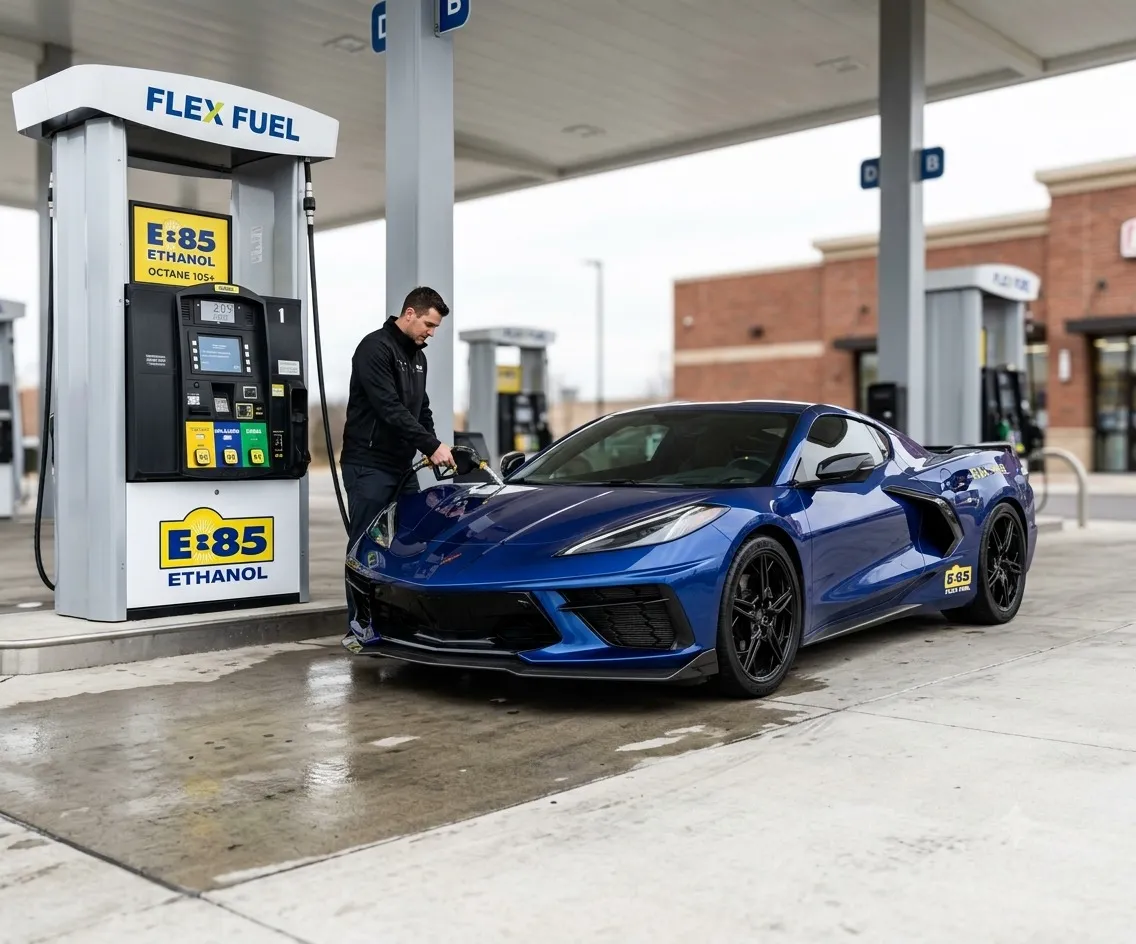
Flex fuel is a type of fuel technology that gives drivers more choices at the pump. It allows a compatible vehicle to run on regular gasoline or on gasoline-ethanol blends, and the most common high-ethanol blend in the United States is E85.
Flex fuel and E85 are closely related terms, but they don’t mean exactly the same thing. E85 refers to a high-ethanol gasoline blend, while a flex-fuel vehicle (FFV) is a vehicle built specifically to run on gasoline and compatible gasoline-ethanol mixes.
Flex Fuel vs. E85: What’s the Difference?
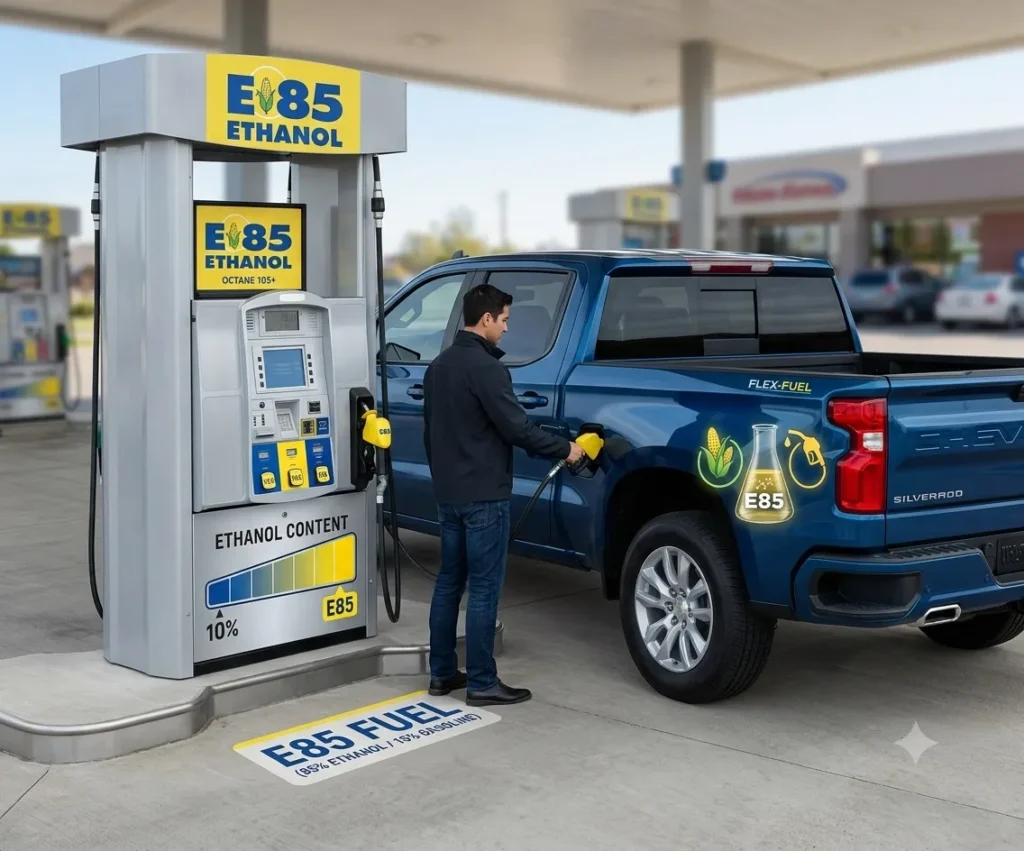
Flex fuel and E85 are related concepts, but they aren’t interchangeable. A flex-fuel vehicle is engineered to run on both gasoline and gasoline-ethanol blends, while E85 is simply the high-ethanol fuel that compatible flex-fuel vehicles can use.
In simple terms, E85 is a type of fuel, and an FFV is a type of vehicle. A flex-fuel vehicle can typically run on regular gasoline, on E85, or on any blend in between, because its fuel system and engine controls are designed to adapt automatically to changes in ethanol content.
This distinction matters because a car’s ability to run on regular gasoline doesn’t automatically mean it can also safely run on E85.
It’s also worth noting that E85 isn’t always exactly 85% ethanol. In the U.S., its actual ethanol content can range from around 51% to 83%, depending on the season and the region where it’s sold.
Understanding where E85 fits among other ethanol blends helps too. E10 contains up to 10% ethanol and is used widely in standard gasoline. E15 contains up to 15% ethanol and comes with its own set of vehicle-use requirements. E85, by comparison, carries a much higher ethanol content and is intended specifically for flex-fuel vehicles.
Ethanol itself is an alcohol-based fuel, often produced from crops such as corn, which makes it a renewable fuel source. Because of this, blending ethanol into gasoline can help reduce overall reliance on petroleum-based fuel.
One of the clearest benefits of flex fuel is the choice it offers drivers. A compatible vehicle can switch between different fuel blends without the driver needing to make any manual adjustments, since the vehicle’s fuel system and onboard computer handle those changes automatically.
What Makes a Flex Fuel Car?
A flex-fuel car is built to handle a range of gasoline and ethanol blends, though it may look identical to a standard gasoline vehicle on the outside. The real differences lie in certain fuel-system components engineered to withstand higher ethanol concentrations.
If you’re not sure whether your car qualifies as a flex-fuel vehicle, the easiest place to start is the owner’s manual. You can also check the fuel door, the fuel cap, or the manufacturer’s official vehicle information, since many FFVs carry a visible badge or label. Official vehicle-information tools can also confirm whether your specific model supports E85.
The vehicle’s electronic systems play a major role in making this flexibility possible. Sensors help determine the fuel mixture currently in the tank, and the engine control system uses that information to adjust how the engine runs, including changes to the air-to-fuel ratio and ignition timing.
This entire process happens automatically and in real time. An FFV can run on regular gasoline one day and E85 the next, with no manual tuning required from the driver, and it can even run on a blend of the two, since the fuel in the tank doesn’t need to be one fixed mixture.
Can My Car Use E85?
Not every gasoline vehicle can run on E85, since this fuel is designed specifically for flexible-fuel vehicles. If you’re unsure whether your car qualifies, start with the owner’s manual, then look for an E85, Flex Fuel, or FFV badge on the vehicle itself. The fuel door or fuel cap can also offer useful clues about which fuels your vehicle supports.
You should never assume that a regular gasoline car can safely handle E85. Always confirm compatibility before filling the tank with a high-ethanol blend, and if your vehicle isn’t built for E85, stick with the fuel your manufacturer recommends.
Using E85 in a vehicle that isn’t designed for it can lead to real problems with the fuel system and engine performance, which is exactly why confirming compatibility beforehand matters so much. In short, a regular gasoline car generally cannot use E85 safely, since high ethanol blends can affect fuel system components and engine operation in vehicles that weren’t engineered for them.
It’s also worth knowing that some conventional gasoline vehicles can be modified with aftermarket flex-fuel conversion systems. These upgrades often involve changes to the vehicle’s electrical system, so using the correct wire gauge chart is important when selecting wiring for fuel pumps, sensors, or other supporting components. Compatibility varies significantly from vehicle to vehicle, though, and these conversions often come with specific legal and emissions requirements. A factory-built FFV is not the same thing as an aftermarket conversion, so if you’re considering one, make sure the system is appropriate for your vehicle and meets all applicable requirements in your area.
The Versatility of Flex Fuel
One of the biggest advantages of flex fuel is simply its versatility. A flex-fuel vehicle gives drivers more options at the pump, letting them choose between regular gasoline and E85 depending on what’s available locally.
This flexibility becomes especially useful when fuel prices shift. In some areas, E85 is priced lower per gallon than regular gasoline, though a lower price at the pump doesn’t automatically translate into lower overall driving costs. That’s because E85 contains less energy per gallon than gasoline, which means vehicles typically get fewer miles per gallon when running on it.
For that reason, it’s worth comparing fuel price against your vehicle’s actual fuel economy rather than looking at price per gallon alone. The right choice ultimately depends on local fuel prices, your specific vehicle, and how much driving you do.
Flex fuel also holds appeal for performance enthusiasts, largely because ethanol offers strong knock resistance. This property gives a properly tuned engine more room to work with when it comes to performance improvements.
That said, simply pouring E85 into a compatible vehicle doesn’t automatically produce more horsepower. The actual performance outcome depends heavily on the engine itself, the fuel system, and how the engine has been tuned.
Is Flex Fuel Worth It?
Whether flex fuel makes sense for you depends on your vehicle, local fuel prices, E85 availability in your area, and your overall driving habits. One clear advantage is flexibility: if you own an FFV, you can choose between gasoline and compatible ethanol blends based on availability and what suits your situation best.
However, E85 usually delivers fewer miles per gallon than gasoline because of its lower energy content, so a cheaper price at the pump doesn’t always translate into a lower cost per mile. For some drivers, the appeal comes down to having more fuel choices, while for others, it’s the potential performance benefits of higher ethanol blends that matter most.
Ultimately, the best choice depends on your vehicle and your personal priorities, so it’s worth comparing E85 pricing against your vehicle’s real-world fuel economy before making a decision.
Performance and Power
Performance is one of the main reasons flex fuel has become popular among certain car enthusiasts. E85’s high ethanol content gives it strong resistance to engine knock, which is the uncontrolled burning of fuel inside the engine.
That knock resistance gives a properly tuned engine extra flexibility, allowing for more aggressive ignition timing or higher boost pressure in some setups, which can translate into increased power for certain engines.
There’s an important distinction, though, between simply using E85 and actually tuning an engine to take advantage of it. A stock flex-fuel vehicle may not see a significant horsepower gain just by switching fuels, since the biggest performance improvements typically come when an engine has been specifically calibrated for ethanol. The engine also needs adequate fuel system capacity, including components like fuel injectors and the fuel pump, to support that shift.
This matters because ethanol contains less energy per gallon than gasoline, meaning an engine often needs a greater volume of fuel to produce the same output. As a result, high-performance applications running on high ethanol blends may require larger fuel injectors, a higher-capacity fuel pump, or other fuel-system upgrades. That’s why performance results can vary considerably from one vehicle to the next.
Some enthusiasts gravitate toward E85 specifically because it supports higher-performance engine builds, while others simply appreciate the flexibility of switching between gasoline and ethanol blends as needed. This knock resistance is a major reason many car enthusiasts favor E85, since it can give a properly designed and tuned engine more room for modification, particularly in turbocharged and high-performance applications. Still, the actual results depend on the engine, the tuning, the fuel system, and the specific ethanol blend being used, so E85 isn’t automatically the best choice for every performance vehicle.
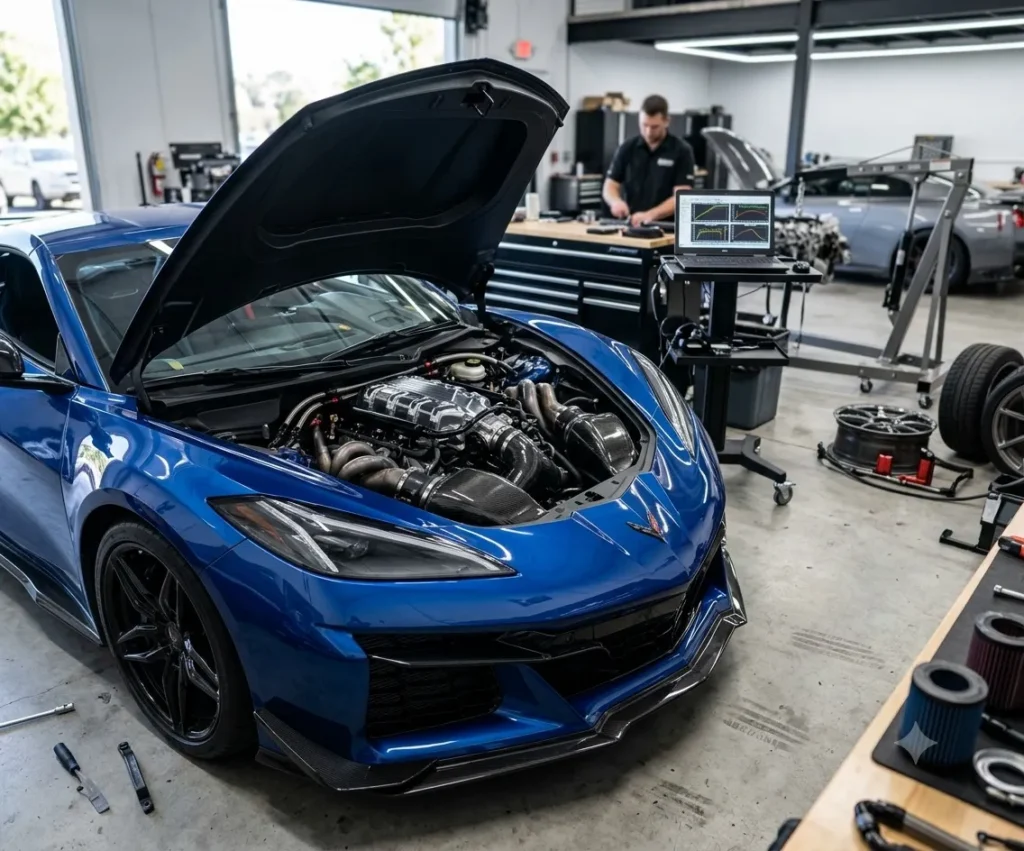
Why Do Car Enthusiasts Use E85?
E85 can help increase power in some engines, but the outcome depends heavily on the vehicle and how it’s set up. Simply filling a flex-fuel vehicle with E85 doesn’t guarantee a large horsepower boost, since the biggest performance gains typically come from proper engine calibration designed to take advantage of the fuel’s properties.
Performance results also depend on factors like compression ratio, boost level, fuel system capacity, and tuning, which explains why one vehicle might see a noticeable benefit while another shows little to no change. If you’re considering E85 specifically for performance reasons, make sure both the vehicle and fuel system are designed to support it, and that the engine has been properly tuned. Many enthusiasts choose E85 because ethanol’s strong knock resistance is genuinely useful in certain high-performance applications. When an engine is properly designed and tuned for an ethanol blend, that fuel can support performance-focused setups, which is especially appealing for turbocharged and modified engines.
Even so, E85 doesn’t automatically make every vehicle faster, since results still come down to the engine, fuel system, calibration, and ethanol content involved. For many enthusiasts, the real appeal lies in the combination of performance potential and fuel flexibility, since a compatible flex-fuel vehicle can run on gasoline for everyday driving and switch to an ethanol blend whenever the fuel and vehicle setup make that beneficial.
Can You Convert a Regular Car to Flex Fuel?
Some gasoline vehicles can be converted to run on higher ethanol blends, though not every vehicle makes a good candidate for this kind of conversion. A flex-fuel conversion typically involves changes to the fuel system, sensors, and engine calibration, and the exact requirements vary depending on the vehicle and engine in question.
If you’re considering a conversion, compatibility should be your first concern, along with confirming that the conversion system is certified and meets emissions requirements in your area. A factory-built flex-fuel vehicle isn’t necessarily the same as an aftermarket conversion, so it’s worth researching the specific system thoroughly and confirming it’s appropriate for your make and model before making any modifications.
Where Can You Get Flex Fuel?
E85 is available at many fueling stations across the United States, though it’s still not as widely available as regular gasoline. Availability can vary quite a bit by state and region, so it’s a good idea to check local stations before relying on E85 as your primary fuel.
The U.S. Department of Energy’s Alternative Fuels Data Center offers a station locator that can help drivers find nearby E85 fueling stations, which is especially useful given that E85 isn’t available at every gas station and its availability varies by location.
When you’re at the pump, look for the clearly marked E85 fuel label, and always double-check your vehicle’s fuel requirements before filling up. If your vehicle isn’t approved for E85, stick with the fuel your manufacturer recommends instead.
For FFV owners, the decision often comes down to price and convenience. If E85 is nearby and noticeably cheaper than gasoline, it may be worth considering, though fuel economy still deserves a close look.
For example, imagine gasoline costs $3.50 per gallon while E85 costs $2.80 per gallon. At first glance, E85 looks like the cheaper option. But if your vehicle gets 25 miles per gallon on gasoline and only 20 miles per gallon on E85, the actual cost per 100 miles ends up being the same. This is exactly why price per gallon shouldn’t be the only factor you consider.
Flex Fuel Delivers
Flex fuel gives drivers more choices, and it gives car enthusiasts another way to explore engine performance. So why do enthusiasts love flex fuel so much? For many, the appeal comes from a genuine combination of performance potential and everyday flexibility. Ethanol’s high knock resistance can support certain performance-focused engine setups when paired with the right fuel system and tuning, while a flex-fuel vehicle still gives the driver the freedom to choose gasoline or a compatible ethanol blend whenever it makes sense.
For everyday drivers, the biggest benefit is often simple fuel flexibility, since a compatible vehicle can run on different gasoline and ethanol blends as prices and availability shift. For enthusiasts, the appeal tends to look a little different: ethanol’s high knock resistance makes it genuinely useful for certain performance applications, and with the right engine and tuning, E85 can support higher power levels.
Performance is only part of the story, though. E85 can come with lower fuel economy, isn’t available at every station, and isn’t suitable for every vehicle, which means flex fuel isn’t a universal solution for every driver. Instead, it’s a solid option for people who own a compatible vehicle and understand both the benefits and the trade-offs involved.
Whether your priority is fuel choice, cost, renewable fuel, or performance, flex fuel offers something genuinely different from traditional gasoline. The key is understanding how the technology works and confirming your vehicle’s compatibility before making the switch to E85.
For enthusiasts, flex fuel can open the door to new performance possibilities. For everyday drivers, it simply offers another fuel option worth considering. That blend of flexibility and performance potential is exactly why flex fuel continues to attract attention across the automotive world.
What Happens If You Put E85 in a Regular Gas Car?
E85 is intended for flex-fuel vehicles, so if your vehicle isn’t designed to use it, you shouldn’t treat it as a regular fuel option. Check your owner’s manual or contact the manufacturer directly to confirm the correct fuel type for your car.
If you accidentally put E85 into a gasoline-only vehicle, avoid continuing to drive until you know what your manufacturer recommends, since the appropriate next step can depend on how much fuel was added and which vehicle is involved.
Frequently Asked Questions About Flex Fuel
What is flex fuel?
Flex fuel refers to fuel systems that allow a compatible vehicle to run on gasoline and gasoline-ethanol blends. Flexible-fuel vehicles, or FFVs, can automatically adjust to different ethanol levels in the fuel.
Is flex fuel the same as E85?
No. Flex fuel and E85 are related but not the same thing. E85 is a high-ethanol fuel blend, while a flex-fuel vehicle is designed to run on gasoline, E85, and other compatible ethanol blends.
Can any car use E85?
No. E85 is intended for flexible-fuel vehicles. A standard gasoline vehicle may not have the fuel system or engine controls needed to handle high ethanol blends. Always check your owner’s manual or the manufacturer’s specifications before using E85.
How do I know if my car is a flex-fuel vehicle?
Check your owner’s manual, fuel door, or fuel cap for E85 or Flex Fuel information. Some vehicles also have a Flex Fuel or FFV badge. If you are still unsure, confirm compatibility with the vehicle manufacturer before filling the tank with E85.
Does E85 increase horsepower?
E85 can help support more power in some engines, but it does not automatically increase horsepower. The results depend on the engine, fuel system, compression ratio, boost level, and tuning. A properly tuned engine can take better advantage of ethanol’s strong knock resistance.
Why do car enthusiasts like E85?
Many enthusiasts like E85 because of its high knock resistance and performance potential. When an engine is properly designed and tuned for ethanol, E85 can support higher boost or more aggressive tuning in some applications. It can also give FFV owners the flexibility to switch between gasoline and ethanol blends.
Does E85 reduce gas mileage?
Usually, yes. E85 contains less energy per gallon than gasoline, so vehicles often get fewer miles per gallon when using it. This means drivers should compare fuel prices with actual fuel economy instead of looking only at the price per gallon.
Is E85 cheaper than gasoline?
E85 can be cheaper per gallon than gasoline in some areas, but that does not always make it cheaper to drive. Because E85 typically provides lower fuel economy, the better comparison is the cost per mile or cost per 100 miles.
Is flex fuel worth it?
Flex fuel can be worth it if you own a compatible vehicle and have convenient access to E85 at a competitive price. It can also appeal to enthusiasts who want to use ethanol’s performance benefits. The right choice depends on fuel prices, availability, fuel economy, and your driving needs.
Can you convert a regular car to flex fuel?
Some vehicles can be modified to use higher ethanol blends, but not every car is suitable for conversion. The process may require changes to the fuel system, sensors, and engine calibration. Any conversion should be checked for vehicle compatibility and applicable emissions requirements.
What happens if you put E85 in a regular gas car?
E85 should not be used in a gasoline-only vehicle unless the manufacturer specifically approves it. If you accidentally add E85 to a regular gasoline car, check the owner’s manual or contact the manufacturer for guidance before continuing to drive. The correct steps can depend on the vehicle and the amount of E85 added.
Conclusion
Flex fuel gives drivers another option at the pump. A flexible-fuel vehicle can run on gasoline and compatible ethanol blends, including E85, giving owners more flexibility when choosing fuel based on price, availability, and driving needs.
That said, E85 isn’t the right choice for every vehicle or every driver. It can deliver fewer miles per gallon than gasoline, it isn’t available at every fuel station, and it’s essential to confirm your vehicle is actually designed to use it before filling the tank.
For car enthusiasts, E85 offers a distinct advantage in its strong resistance to engine knock, which can be genuinely useful for certain performance applications when the engine and fuel system are properly set up and tuned.
Ultimately, the value of flex fuel comes down to what you need from your vehicle. For some drivers, it’s about having more fuel choices. For others, it’s about exploring the performance potential that ethanol blends can offer.
The key is understanding how flex fuel works, confirming whether your vehicle is compatible, and weighing the trade-offs before choosing E85. With that knowledge in hand, you can decide whether flex fuel is the right fit for your vehicle and your driving goals.